An Innovation Economy Empowered by Capable Systems
Daniel Falzon (3 ta’ Ġunju 2026)
The Leader of the Opposition recently argued that Malta needs an innovation economy, and that this means we should
"measure our success with data, be transparent about it and remain accountable to people."
I want to take that principle seriously, because it is easy to state and much harder to build. If we mean it, the first place to prove it is in how government runs itself.
Consider how we approve what gets built. The Development Planning Act does not lack standards. It requires that decisions have regard to the published plans and policies, that reasons be given, and that the authority monitor development for compliance. On paper, the system is sound. But notice what it measures. It checks whether a process was followed, not whether the result was any good. A project can satisfy every procedural requirement and still be a poor use of public land and money. The system optimises for compliance, not quality.
In software engineering, you do not start building until the problem is clearly defined. A problem statement comes first: what are we solving, for whom, and how will we know it worked. That definition is what you measure the result against later. Public projects rarely begin this way. The objective is seldom stated plainly or published, so when the works are done there is no shared benchmark against which the public can judge whether they succeeded. Any engineer would recognise this as an open loop: without a defined goal and a way to check against it, a system cannot learn, and it repeats the same mistakes, perfectly legally.
I do not have to look far for what this costs. On Triq il-Wied, where I live, I watched rainwater culverts be installed and then dug out and removed. I am aware of no acknowledgement that anything went wrong; as far as I have seen, the position is that the works proceeded as planned. Yet the same kind of culvert, in localities like Birkirkara and Naxxar, seems perpetually under repair, often left covered by the temporary metal plates that have become a familiar sight. I cannot prove these failures share a single cause. But a system that learns would not keep producing the same visible problem in one place after another. The process is followed each time. The outcome keeps disappointing.
We do have an independent check. The National Audit Office evaluates projects after the fact, and that is exactly the kind of measurement we need. In its February 2026 follow-up, the NAO examined the Planning Authority, which had genuinely overhauled its procedures and was rightly commended for it. Yet on testing actual compliance, it found that three of nine direct orders above ten thousand euro still skipped the authority's own required check. The rule had been written. It simply was not always followed. If that can happen at a reformed authority under scrutiny, consider the gaps where no one is looking.
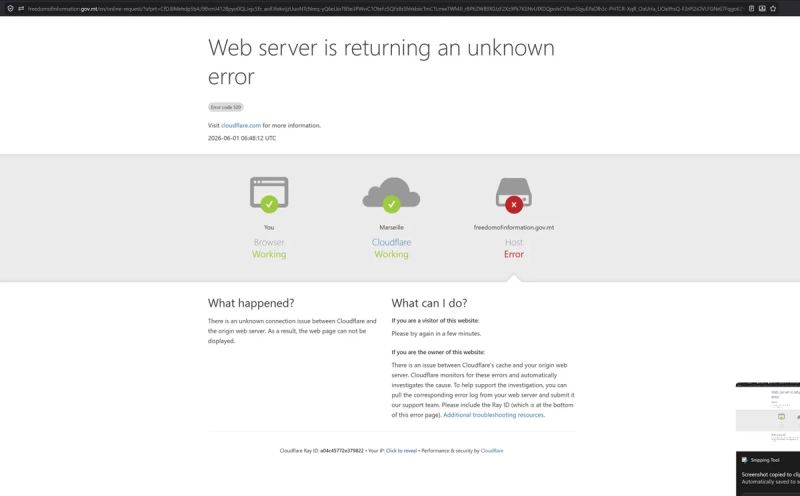
That is the heart of it. Our oversight is occasional and private, arriving long after the money is spent. The tool citizens are given instead is the Freedom of Information request: ask, wait, and hope. On the morning I sat down to write this, the FOI portal was returning a server error and would not load at all.
In software, we learned this long ago. You do not make people hunt for information and force them to request it. You surface it automatically, the moment it matters. The records that prove a decision was made properly are not commercial secrets, and the law already separates those from genuinely confidential material. They could be published by default, so the public is empowered to judge for itself.
An innovation economy, as the argument goes, is a systems economy. A good system measures its outcomes, publishes them, and learns. If we want the private sector to run on those principles, the state should run on them first.
Artikli Oħra
Ikkuntattjani
Tixtieq tikkollabora fuq proġett jew tiddiskuti xi blog post tiegħi? Tiddejjaqx tikkuntattjani!